17 February 2014

Some Thoughts on Higher Education

I'm in an emotional state and will probably disagree with this analysis to some extent at a later, cooler date, but here goes anyway.

College is a waste of time. The majority of my experience thus far has been an abject farce. In a capitalist society, these atavistic juggernauts would have died long ago, but the mixed economy has a special talent for preserving the worthless at the expense of the innovative.

My two freshman semesters were spent in a monstrosity euphemistically named "First Year Engineering." We learned nothing. Project Lead the Way taught the design process much more accurately to students four years younger in an hour. We waddled our way through the usual "diversity" bullshit and all the non-technical garbage of that nature.

First Year Engineering did teach us one thing: MATLAB, the primary calculating tool used here. But I think it's safe to say that only a blubbering moron could have done a worse job. Six weeks of variations on descriptive statistics--really? Then slamming us with graphic user interfaces--which naturally have so much to do with anything we'll be doing.

But what makes me write tonight is the science departments, though FYE fits into the broader theme. The individual engineering departments I've taken course in (to date, Aerospace and Mechanical) have generally been pretty well managed, though of course they had considerable room for improvement. But the pre-requisite classes in the mathematics and sciences divisions are absolutely disastrous. Why is that?

I think it's because students have no where else to go. Engineering students such as myself have to choose what flavor they want to take, and (especially in the first semesters) students will change if they decide that it isn't their cup of tea. The departments are in competition for students, even if they have a large base that will struggle through so long as the money hold out (myself with aerospace, for example).

But the basic math and science courses don't have that problem, do they? Once a course is added to an Engineering Department Plan of Study, they have a steady supply of students. It's very rare for a course to be struck from a P.O.S.

And we see the natural failure of a bureaucracy not subject to competition. Without the need to attract students, the professors have no strong motivation to correct mistakes in their content, improve their teaching methods, and so on. Only when too large a percentage of students start failing--and suddenly their tenure becomes suspect--does anything change.

First Year Engineering fits this mold, interestingly enough. They have a steady supply of students, most of whom will stick it out till they can move on to the greener if more arid pastures of their majors. They have absolutely no incentive to improve, and the bureaucracy there is worst than anywhere else. (From what I've heard described, I couldn't design a less-efficient system if I tried.)

How do we fix this problem? Here are a few suggestions:

  • Just abolish set plans of study. Let students pick and choose what courses they want to take.
  • Abolish tenure. Professors that can't teach, should either be taken away from teaching or forced onto the labor market.
  • Increase the test-out options for students. If you can demonstrate you know the material, you shouldn't have to sit through useless introductory classes, forgetting more than you learn.
What I can say is this: if the problem isn't fixed by the time my children are ready to attend college, I'm not going to send them. Period. If they want to get ripped off, they can do it on their own dime.

In fact, I'd advise everyone to opt-out of college to the maximum extent possible. Our educational system is broken, and no amount of tinkering is going to fix it. We need to throw it out and start over, but that will never happen until we're willing to stop feeding the beast.

16 February 2014

The High School Research Paper: A classic exercise in futility

It's one of the classic rites of passage in high school. Choose a topic you know little or nothing about, pull a thesis out of thin air, find a number of sources that somehow seem to support it, and slap the whole thing together into something generously called a paper. Rinse and repeat yearly, without learning anything significant in the process.

It's absolutely worthless, and an incredible waste of time.

Presumably, the high school research paper was invented to prepare students for the papers they would have to write in college. In practice, the value of the research paper, as opposed to other sorts of reports, is nil. Let me explain.

In college, one's studies are very concentrated, and few students write papers outside of their major after the introductory years, if at all. The key difference here: college papers are almost always on a topic the writer knows a great deal about.

High school papers are almost always about a topic the student doesn't know much about, which negates any value that the assignment might have in teaching methods. The high school student doesn't know the relevant academic journals and where to get them, has little or no access to specialized libraries, feels little love for the subject.

The value in high school research papers is to teach the methods, but in nearly every case, the elements are overlooked in the desperate struggle to collect sources and cobble together a reasonable theme. The value in citation, communication, and nuance is lost.

In my personal experience, a variety of smaller assignments were more conducive to teaching the desired skills. Short reports can teach sourcing and research methods without the pressure of collecting a great number. Citation-free themes can teach students to organize their thoughts. More reasonably-sized research papers can teach the integration of these techniques.


As with so many problems in education, it's the one-size-fits-all mentality to blame. All students are going into liberal arts , so naturally they need to know the methods that English majors use to write their analyses of limericks. But many students aren't. Engineers and scientists need to write lab reports. Historians need to instruction in finding materials. Educators need to know lesson planning. No two students have precisely the same needs. But onward we march, Taylorist machines, towards the future the central-planners have designed for us.

09 February 2014

Suggestions for creating a libertarian country

If you spend much time around libertarians, you'll inevitably run across the totally genius idea of creating a new, libertarian nation. This has been tried in various ways before, and it usually fails quietly or catastrophically. That said, there's still a lot of unrealized potential for new country projects.

Since first encountering this idea, I've had a few insights about why it usually doesn't work out.

Be realistic

Most new country projects are handicapped by their founders rosy visions of utopia. A perfect anarcho-capitalist Free Territory or minarchist republic isn't going to happen anytime soon, and getting hung up on this accomplishes nothing. Going for a basic liberal capitalist democracy with a good constitution and above-par citizenry is much more practical.

A country is not a business model

Perhaps because new country projects are often cultish in nature, they often appropriate some of the worst ideas of new religious movements. In particular, running the new [thing] as a business.

Neither a nation nor a religion is a business model. A religion is a means for gaining moral guidance; a nation, safety and stability. Nations and religions develop for pragmatic reasons, and are only subverted by others at a later date.

Now, in the case of our libertarian micronation, the pragmatic reason is to develop a state that's capable of defending laissez-faire. Once that system is established, becoming wealthy from it is your own responsibility. Otherwise, the erstwhile libertarian is just another statist moocher.

Political Parties > Constitutions


Practically all of the libertarian new country proposals put their emphasis on the constitutions of these new countries, trying to avoid thinking about political parties. While building the legal framework for maintaining freedom is essential, I think that setting up the philosophical and social institutions necessary for preserving liberalism is an equally important job. A good constitution will not constrain those bent on perverting it (consider our own).

Instead, I think the nation-architects should focus on planning one or more liberty-minded political parties. I say multiple, because a duo or trio of parties might maintain equilibrium better than a single movement. Have these planned and ready to roll out upon independence, and you might be able to sustain freedom for a few generations.

Obviously, none of these solve the basic problem of raising the necessary funds to convince a government to part with some of its territory, or to build some of your own.

26 January 2014

Personality Type and Social Organization

A lot of people put too much stock in personality tests like the Myers-Briggs, myself included. I'm still curious whether the results could be applicable to social structure.

For instance, NT types are supposedly skilled at theoretical analysis, and SF types are good at dealing with people. Could an organization use NTs to make many of the detailed decisions with broad implications, and the SFs to help maintain internal cohesion?

The psychologists in Human Resources should look into this. It'll do more to maximize your profits than just refusing to hire introverts because reasons.

16 January 2014

Critique of Micronationalism

I first found out about micronationalism about five years ago, and have generally enjoyed my forays into that world. Looking back, though, there are a few criticism that I'd like to lay out.

These fall into two basic categories: important problems and unimportant quibbles. We'll start with the quibbles first.

Quibbles with Micronationalism

Okay, what's with the ridiculous names? It's like some of these people take an eastern European province and mash it together with a Russian transliteration and used it to name a country. Or it sounds like a realm from some fantasy novel. Or is hyperspecific (Principality of Hutt River is downright clean compared to most). I know that's a pretty silly thing to get worked up about, but after awhile I'd just like a nice [Republic/Kingdom] of [Normal-sounding place-name].

Similarly, their online presence leaves something to be desired. A few paid to have nice websites built, but most just took a course in HTML and went to town with it. In both cases, their websites are usually difficult to navigate and full of contradictory or redundant information. This leads me to one of my more serious criticisms.

Serious Problems in Micronationalism

Micronations, generally, aren't very well planned. Usually they start out as creative exercises in imagination that stick for entrepreneurial reasons. Naturally, this leads to some very weird histories, including outright fabrications. Because they aren't very well planned, micronationalists often come off pretty whiny in their attempts to gain independence and recognition, even when run by relatively stable and responsibly individuals (anyone who finds the idea of setting up a new country in your back yard is a little weird, myself included).

I think the reputation of micronations actually hurt serious independence movements and new country projects. When micronationalists declare the People's Republic of Backyardlandia, they draw negative media attention to the idea of setting up a new country. While well-organized micronations could help foster the idea in people's minds, for the most part, they taint the public perception of separatism.

At risk of sounding like an altruist, I'd advise micronationalists to think about others and put their own immediate interest aside for the sake of independence movements everywhere. Focus on developing community and identity before working on sovereignty. If you've got a reasonable large community that wants to secede, then go for it. Until then, keep the games to yourself.

That's some advice I could afford to follow, too.

14 January 2014

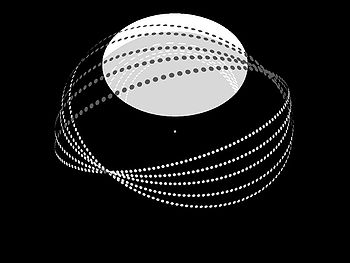
Shkadov Thrusters

Shkadov Thruster and Dyson Rings (via Wikipedia)
A Shkadov Thruster is a proposed sort of stellar engine, which would be used to move an entire star system by redirecting the primary's radiation pressure. A star being piloted by a Shkadov Thruster wouldn't move very fast (if we built one for Sol, after 1 million years we would have moved less than .1 parsec), but given enough time it could end up moving fast relative to the surrounding stars.

Of course, the Sun is probably bigger than need be. A particularly luminous but much less massive star could accelerate much faster. Alternatively, a somewhat more massive but much more luminous star (F3, for example) might accelerate faster (I haven't done the math on it).

Additionally, energy collected by a Class C engine could supplement the thruster's thrust. Suppose a ring of collectors was set up about the star's equator, and the thruster was located above one the poles. The energy that might have headed out from the equator could instead by directed to electric propulsion drives.

What sort of star to use for this would depend in large part on how fast and far the architects want to go, and how long they want to be able to see returns on their investment.

06 January 2014

Sleep

They say admitting you have a problem is the first step to recovery. I'm not sure precisely how true that is, but I'll put it out there. I sleep too much.

Perhaps it's because even on nights when I don't have insomnia it takes me a long time to go to sleep. Perhaps it's because upon waking I find the world no better than I left it, and dive back down. Perhaps my body is still too weak and feeble to operate on less than ten hours without complaining. Or maybe I'm just perpetually dehydrated.

It doesn't help that I think my cycle is longer than 24 hours. I could sleep twelve hours and then stay awake for sixteen, easily. In fact, that would probably be more efficient than what I do now. Unfortunately, our civilization is still dependent on daylight, and I am too dependent on "civilized" people to break from that cycle.

05 January 2014

New Year's Resolutions

I made two resolutions this year: floss five times a week, and start using the Periodic Calendar more. I'm also going to try to post weekly.

Goals for the New Year, on the other hand, I've yet to finalize.

29 December 2013

What would I even call this?

I'm very tired and will probably question this in the morning, but I want to get this out. Sometimes I just really don't understand my mother.

This probably doesn't seem surprising but I feel (special pleading alert!) that my situation is unusual. We're both INTJs, we're both fairly intelligent, but we completely differ in our approach to living.

In particular, I just can't seem to wrap my head around why she'll suggest one thing and then wonder how anyone could ever do something so stupid as what she suggested! It's like she's completely incapable of seeing how her own behavior prevents the very behavior she wants out of me.

All I want is to just be left alone long enough to get something done. That'll never happen. And then the damn fools will wonder why it never got done.

How anyone has a family and doesn't believe in laissez-faire is utterly beyond me.

27 December 2013

Anti-Capitalism and Misanthropy

I've been reprising my summer job at a retail store over the holiday break, and naturally I've been just astounded by the ridiculous sorts and quantities of things that people buy. While I will admit that the store's prices are a lot lower for various reasons, I still don't see the reason why anyone other than a millionaire or newlyweds would buy so many lamps, vases, or plates, not to mention the endless stream of trinkets and doo-daas.

The work doesn't nearly approach occupying my mental capacity at all times, so in my mental meandering I realized something interesting. Hating commercialism is often an alternative to hating people, or more precisely, hating people's vapidity. All too many people think that commercialism causes the vapidity, when in reality, vapidity is what made commercialism possible in the first place!

Following this line of thought, we see that anti-capitalism on both the left and right (colloquially known as socialism and fascism, respectively) is a misanthropically-motivated desire to control people because they're obviously too stupid to run their own lives. Whether or not you believe that's true (I think in a lot of cases it is), that's no proof that you would be any better at the job. It certainly doesn't justify totalitarianism. That's of no consequence to the totalitarian, who believes himself—through the state—perfectly worthy of controlling other people.

The socialist anti-capitalist believes that if we can end capitalism, we can free people of their vapidity. The fascist anti-capitalist is more honest, believing that since people are vapid, we must control them through the state to subdue their vapidity. Europe's history of socialism and fascism in the 20th century should be sufficient evidence that neither approach will work.

Looking at my own political history, I see elements of both viewpoints. I hated industry like a good little ecosocialist, but in other ways could have been described at proto-fascist in my views. Fortunately I came around to see the folly of authoritarianism many years before I could vote, and learned some valuable lessons from it.